

1. Many newcomers to these two types of equipment easily confuse purifiers and centrifuges-after all, they both seem to "clean things up." However, if you break down their working principles, you will find they follow completely different technological paths.
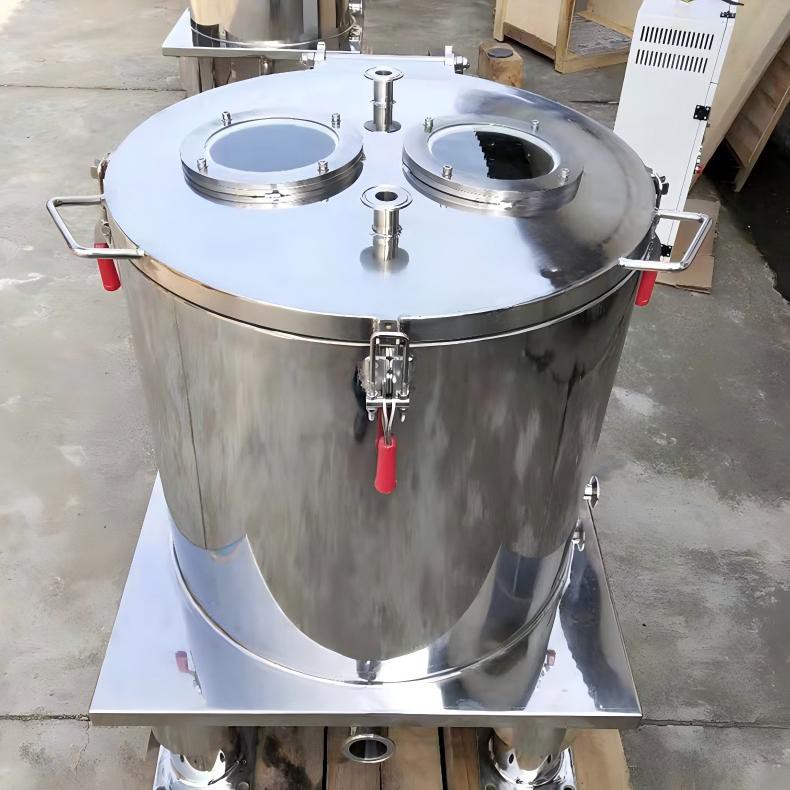
2. Purifiers: Focused on Impurities
The goal of a purifier is singular: to improve purity. Whether it is a gas or a liquid, its focus is always on the "impurities" within, and it removes them selectively through physical or chemical methods.
Common technological approaches include using adsorbents (such as activated carbon or molecular sieves) to capture moisture, oil, and CO₂; using ion exchange resins to replace metal ions in liquids; or, as seen in laboratory acid purifiers, using thermal radiation to evaporate and then condense, reducing metal impurities from 10 ppb to below 0.01 ppb.
Typical applications are also straightforward: semiconductor production lines require high-purity nitrogen of over 99.9999%, and ICP-MS analysis has stringent requirements for ultrapure acids. In these scenarios, purifiers are an indispensable choice.
3. Centrifuges: Focused on Density
The basic logic of a centrifuge is physical separation-using the centrifugal force generated by high-speed rotation to separate components of different densities and particle sizes. It does not aim to "purify" a particular phase but rather to separate the components within a mixture.
The most intuitive example is a washing machine's spin cycle: water is spun out, while the clothes remain. On an industrial scale, the same principle applies to separating cells from fermentation broth, extracting cream from milk, and collecting plasma from blood.
The core value of a centrifuge lies in "separation," not "purification." If you need to recover cells, dehydrate suspensions, or classify particles by size, a centrifuge is the right tool.
4. Combined Application of Purifiers and Centrifuges
A typical bio-fermentation process works like this: first, the cells are quickly separated from the fermentation broth using a centrifuge; if small-molecule impurities remain in the broth, it is then further purified using a purifier. Combining coarse separation with fine purification is more efficient than using either method alone.
5. Selection Guidelines
High solids content (above 10%), large particle size, requiring rapid dehydration → Centrifuges are the preferred choice; the specific model depends on the material characteristics.
Extremely low solids content (<1%), fine particle size (<5μm), high viscosity → Tubular centrifuges are more suitable for these conditions.
Target product is high-purity gas or ultrapure reagent → Purifiers are the best choice.