

Green Revolution in India's Textile Industry: Arvind and H&M Launch Supercritical CO₂ Dyeing Equipment
The global textile industry is transitioning toward sustainability. Arvind Limited, a leading Indian textile manufacturer, the H&M Group, and Deven Supercritical, a technology innovation firm, have partnered to install India's first commercial supercritical CO₂ dyeing equipment at a facility in Ahmedabad. This technology, named SUPRAUNO, has been granted a global patent. It represents a significant advancement in green manufacturing for India's textile industry.
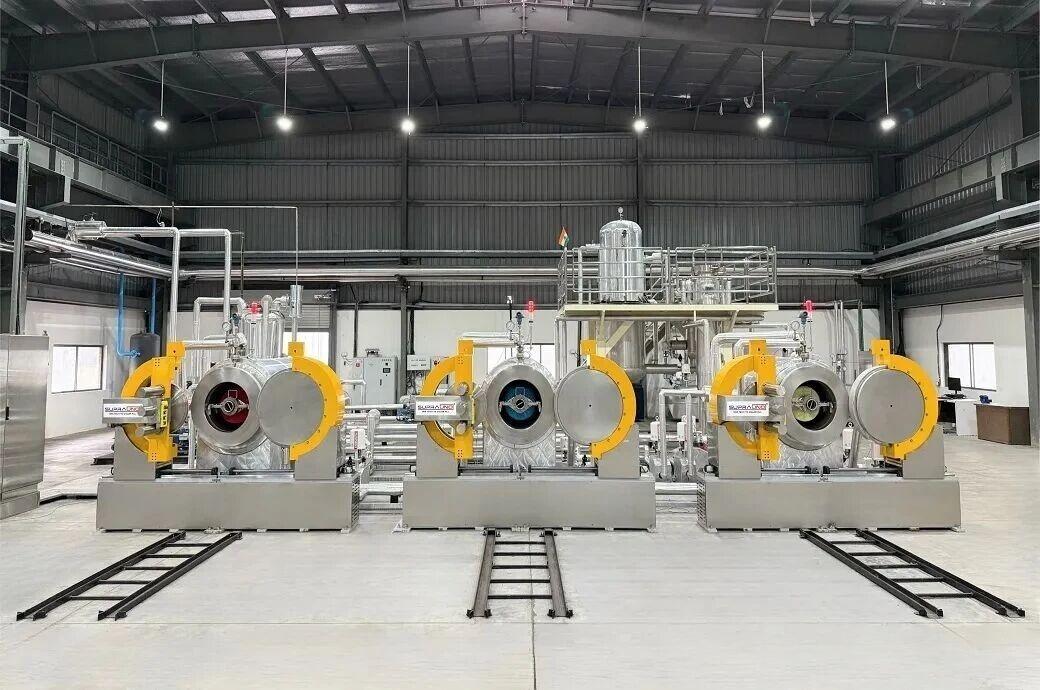
Technological Breakthrough: Dyeing Reinvented
The core of supercritical CO₂ dyeing technology lies in utilizing the unique properties of carbon dioxide in its supercritical state. This state is achieved at temperatures above 31.1°C and pressures exceeding 7.38 MPa. Under these conditions, CO₂ exhibits both the high diffusivity of a gas and the strong solubility of a liquid. It can carry dye molecules deep into fibers, enabling a waterless dyeing process. Compared to traditional water-based dyeing, this technology drastically reduces resource consumption:
1.76% reduction in water usage: completely eliminates water consumption and effectively avoids printing and dyeing wastewater.
2.67% reduction in energy consumption: a simplified process that omits the traditional high-temperature drying step post-dyeing.
3.90% reduction in chemical usage: dyeing is achieved using only CO₂ and dyes, with no auxiliary chemicals required.
4.Near-zero pollution: virtually no toxic wastewater is generated, substantially reducing environmental impact.
Tripartite Collaboration: Deep Integration of Innovation and Industry
This collaboration exemplifies an efficient model of "technology R&D – industrial application – market promotion":
1.Deven Supercritical serves as the technology provider, having overcome engineering challenges such as high-pressure sealing of supercritical equipment and uniform dye dispersion.
2.Arvind contributes its experience in large-scale production, successfully transitioning the technology from laboratory to factory implementation.
3.The H&M Group drives sustainable sourcing demand, which in turn stimulates technological adoption and creates market space for green products.
This approach reduces the risks associated with the industrialization of innovative technologies and offers a replicable industry-research collaboration model for the textile sector.
Industry Impact: Upgrading the Value of India's Textile Industry
India is the world's second-largest textile exporter, and the textile industry accounts for 7% of India's total industrial output. Environmental pollution from traditional wet dyeing processes has become increasingly prominent. The introduction of supercritical CO₂ technology is expected to bring three major changes:
1.Environmental Compliance Advantage: helps manufacturers meet increasingly stringent international environmental standards, such as those under the EU REACH regulation.
2.Optimized Cost Structure: although initial equipment investment is high, long-term savings can be achieved in water, wastewater treatment, and energy costs.
3.Enhanced Product Value: textiles produced with the "waterless dyeing" green label are more attractive to international brands.
Technology Promotion and Industrial Ecosystem Development
The widespread adoption of supercritical CO₂ dyeing technology still faces challenges, including the high cost of high-pressure equipment manufacturing, the need for specialized dye formulation optimization, and the requirement for skilled operation and maintenance expertise. The Arvind project serves as a demonstration, attracting more companies to enter this field. India's Ministry of Textiles has expressed support for promoting the technology. Future measures may include subsidies and tax incentives to accelerate the industry's green transformation.
Companies in China, Europe, and other regions are also actively developing supercritical dyeing technology. India's pioneering commercialization effort demonstrates its commitment to sustainable innovation in textiles. This "green race," though often understated, will accelerate the global textile industry's shift toward resource-efficient and environmentally friendly development models.